Learning to Disappear
In December 1983, my family arrived in Aotearoa New Zealand as political refugees. I am grateful to have been able to call this beautiful country home. Yet I haven’t always been welcomed. As a child, I was different and othered. I was made to change the pronunciation of my name to make it easier for Kiwis. And I became embarrassed of all my qualities that made me different.
I was born in Budapest and escaped along with my parents and brother at a time when Magyarország was still an Iron Curtain country. We went camping in Austria and “got lost” on our way home. We then spent four months traveling around Italy before coming to Aotearoa as political refugees.
With family ready to help us in the United States, Canada, and Aotearoa, my parents decided that the Land of the Long White Cloud would provide the safety, freedom, autonomy, and self-determination which our Motherland, under Russian (Communist) rule, denied us. It was not until I became an adult that I came to fully appreciate the enormity of what we did. I always knew that my parents would have ended up in jail had we been caught – but the weight of that did not fully hit me until much later in life. A smile crosses my face as I notice how my perspective – as well as my meaning making – has changed with the passage of time, the evolution of place (in not only the physical, but also political and historical context), and lived experiences since.
We landed at Auckland airport on 12 December 1983, and our citizenship was granted on 11 July 1988; one year before Magyarország broke free from Communist rule.
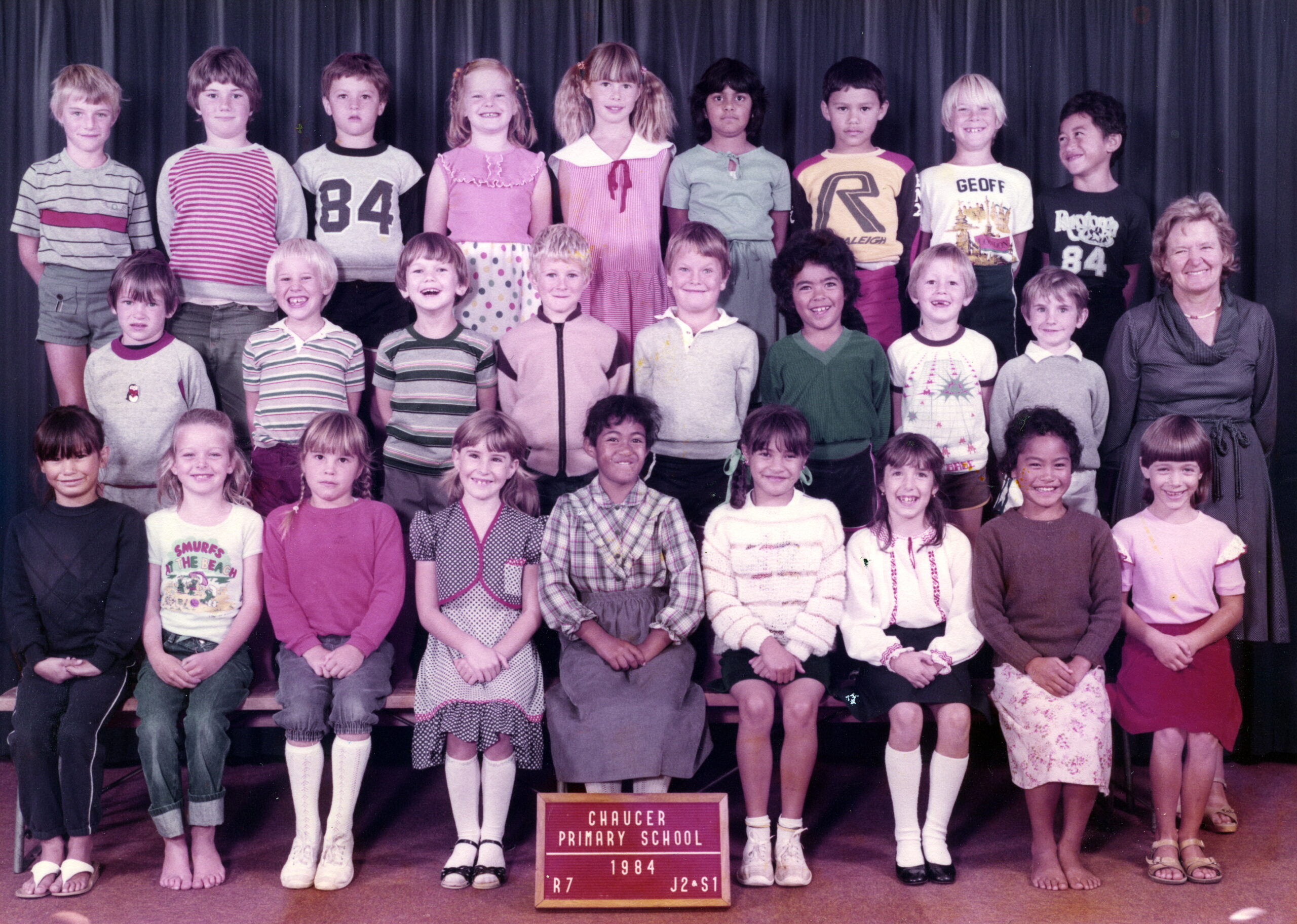
I grew up in West Auckland, in middle-class, predominantly white, suburbia. Aotearoa in the mid-to-late 1980s lacked the cultural diversity of today. All the staff at my primary school were of European descent. Similarly, the majority of the children were European with only a handful in a class of over thirty students being of Māori, Pasifika, or Indian heredity. I have no recollection of anyone from any other Asian culture (for example, Chinese, Korean, Taiwanese, or Vietnamese) in those early school years; and my perception of these demographics is confirmed by class photos.
It is 1984, the start of the school year, and our new lives.
My mother – a seamstress – has been employed by a clothing factory. She spends her days sitting at an industrial sewing machine; making garments for which she is paid a fraction of what she was earning in Hungary; with next to no interaction with co-workers. It isn’t until she starts working from home that she learns the English language through watching (American) daytime television.
My father – an engineer – has gone to work for his cousins in their plastics factory. He spends his days learning about injection moulds and the machinery he will be operating and maintaining for the remainder of his working life. He is fortunate, not only are his relatives fluent in Hungarian, but they employ other Hungarian migrants with whom mt father is able to communicate with in his native tongue. The remainder of the factory staff are predominantly Chinese, who also barely speak a word of English. My father learns to interact with his colleagues through hand gestures and pidgin English; and they bond over the sharing of traditional foods from their respective cultures.
My brother – six years my senior – is enrolled in high school. But first, he must attend English classes taught elsewhere; through an intensive course delivered over several weeks to a group of migrants of varying ages.
As for me – at not yet eight years of age – I am enrolled in the local primary school. There are no ESOL tools or resources available so my teacher creates her own, drawing pictures of common objects on cards for me to pair up with English words. Whilst my parents use dictionaries to translate English to Hungarian (and vice versa) I quite literally learn this foreign language like any newborn learning to communicate.
The First Day
My aunt brought me here,
But is now walking away;
I feel abandoned.
A woman takes my hand,
Leads me inside;
To stand on a section of carpet.
I am frightened,
Nothing is familiar;
So much I do not understand.
I am surrounded by noise,
SO much noise;
I want it to stop.
Girls have formed a circle around me;
What are they saying?
I do not understand.
Boys in the background,
Boisterously playing;
I am scared they will hurt me.
I want to run,
But my body is frozen;
Trapped and unable to escape.
I feel small.
Insignificant.
Powerless.
Despite being amongst predominantly Europeans, I felt like an outsider. By my understanding, I was the only genuine European – having been born in Europe and not speaking a word of English. Indeed, I was a novelty. The popular girls (Upon the encouragement from the teacher to befriend me) took me into their fold. To this day, this experience informs my definition of the term “European” – something I am reminded of every time I complete a form which asks me to indicate my ethnicity. I feel triggered when I read down the list and find no option which I identify with. NZ European, Māori, Samoan, Cook Island Māori, Tongan, Niuean, Chinese, Indian, and Other. I find myself forced to choose “Other”. Thus, reinforcing the othering that I have been subjected to for the past forty years.
In contrast to the primary school which I attended, my intermediate school was a low socioeconomic melting pot of cultural diversity. My form one teacher was Samoan and white skinned kids a minority across the school. All but one of my primary school friends had gone to a different school; I was the outside once again, having to assimilate and form new friendships. This time, I found myself amongst the nerds, misfits, and outcasts. Before long, I became the subject of relentless bullying. In the mornings, the kids would line the corridor and taunt and tease me as I walked to my classroom. During morning tea and lunchtimes, my friends and I would make ourselves as inconspicuous as possible, sitting and playing away from the popular kids. When it came to P.E. classes and sports days, I was always one of the last to be picked for teams. On the way home, I would exit the school bus at the earliest stop and walk considerably further than necessary to avoid any confrontations (having previously been physically assaulted on the school bus – the scar from which is still visible on my wrist today). In a nutshell, I spent my intermediate school years trying to be as invisible as possible; in an effort to keep myself safe from harm.
High school afforded me the opportunity of a fresh start. Only a handful of us moved across to the same high school; and at the same time, I was reunited with some of the kids from my primary school years. I continued to employ the invisibility strategy, successfully avoiding any further bullying for the remainder of my school years, and once again found friendships amongst the nerds, misfits, and outcasts. Under the radar, I remained unseen, and unharmed.