Beyond the Frame
At the end of my last client session yesterday, we kept talking. She is knowledgeable about framing artworks, and I wanted to pick her brain as to how I might frame the Hungarian embroidery I will be embarking upon in the new year.
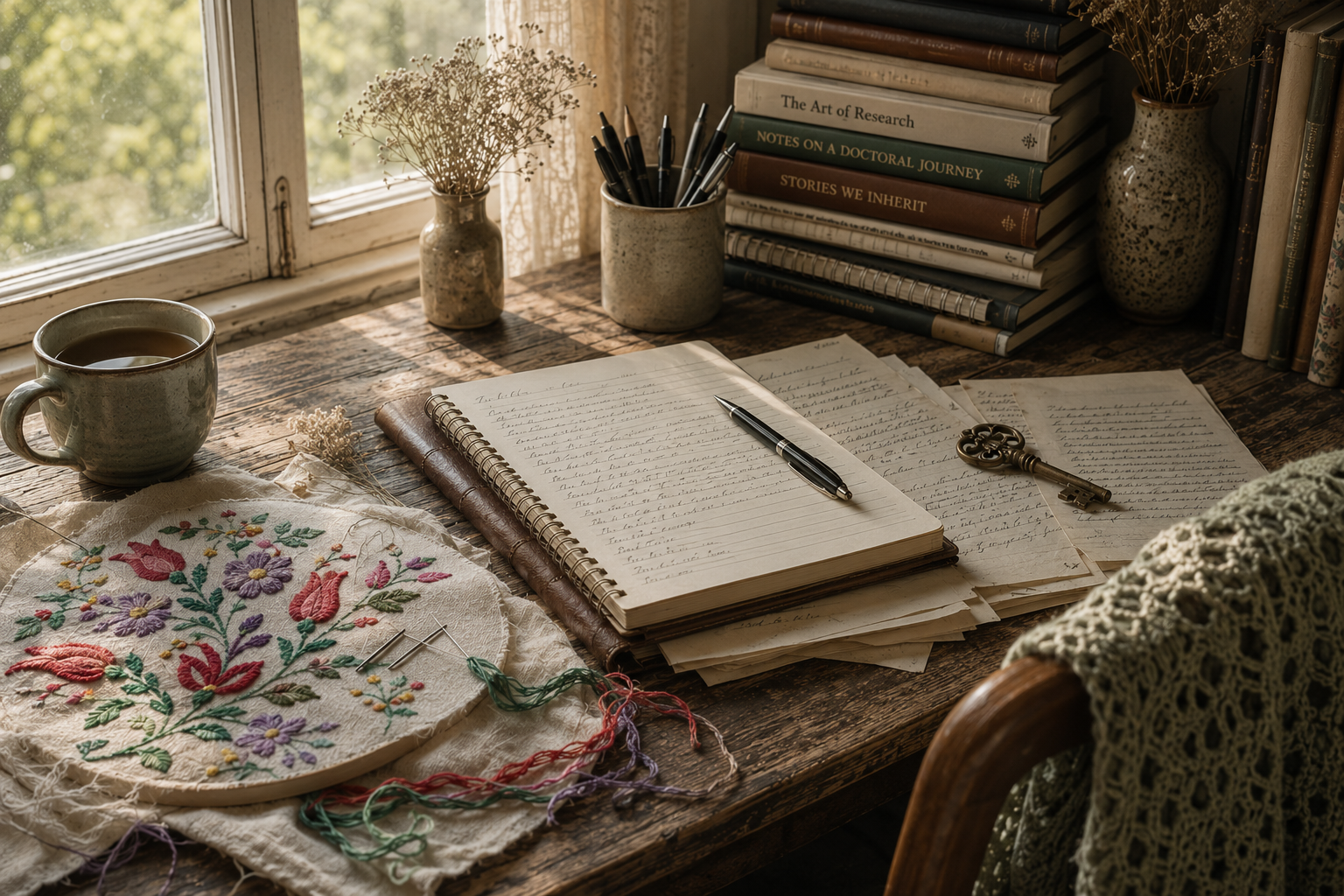
I regaled her with the story of how I had sent Anyuci on a mission to find pre-printed cloth for me to embroider as part of my doctoral project – my vision being a series of small square or round pieces with roses, tulips, and forget-me-nots in traditional Kalocsai style, framed separately. After struggling to find a store that actually sold textile art supplies, we decided to let our fingers do the walking. Much to my delight, Google provided us with several websites to peruse, and the second one I visited had (almost) exactly what I had envisioned.
I had just three pieces in mind – each the same size and shape, but with different patterns. To further complicate things, I wanted these pre-printed fabrics to also have machine-stitched scalloped edges. Whilst the online store had a substantial selection of textiles in a variety of sizes and patterns, my specific requirements limited said selection. In the end, it was down to two options – neither of which fit the brief:
a) Three round pieces with the same pattern; or
b) Three square pieces but with only two different patterns.
Hmmm… we then pondered mixing the shapes: do I go with two square and one round? How would they look visually as a triptych? I just couldn’t visualise it (not helped by my having aphantasia!). In the end, Anyuci said, “Let’s just buy them all and you can decide once you see them side by side.” She argued that they’re really not that expensive (just a few dollars), and I had to agree. So we ordered seven items: three of the round fabrics and two of each of the square ones.
And if that sounds like a mission, wait till you hear about arranging delivery!
Courier deliveries in Hungary are quite a different beast to what we are used to in Aotearoa. Here, we order, we pay, and if we are concerned we will miss the delivery, we arrange an authority to leave the parcel. In Hungary, many people live in apartments – so leaving a parcel by someone’s front door isn’t practicable. Instead, many people have a parcel locker or collection point where they can receive parcels. Obviously, this isn’t something Anyuci subscribes to whilst visiting Hungary. So her only option was to ensure that she was home to receive said parcel – not ideal when she has a fairly full social and sightseeing calendar, but we had no other option with an online store.
The next hurdle was payment. They didn’t accept credit or debit card payments, and Anyuci was having difficulty entering their bank details via internet banking. And then we found another option… apparently, she could pay the courier with cash. Amazing. And that is precisely what she ended up doing. She acquired the exact amount of cash and was able to liaise with the courier for an approximate delivery time.
It all worked out in the end, and I had the pleasure of watching Anyuci open the parcel via video call. She had intended to have me open the parcel once she was back in Aotearoa, but in the end agreed that opening it and discarding the packaging would help with her packing for the return trip.
So back to yesterday’s conversation with my client…
I explained that Hungarian embroidery has a long history. I actually misquoted and said it had been dated back to the 1300s – when in fact it has been traced back to 1031, when the coronation garment of King Stephen I (also known as St Stephen of Hungary) was embroidered.
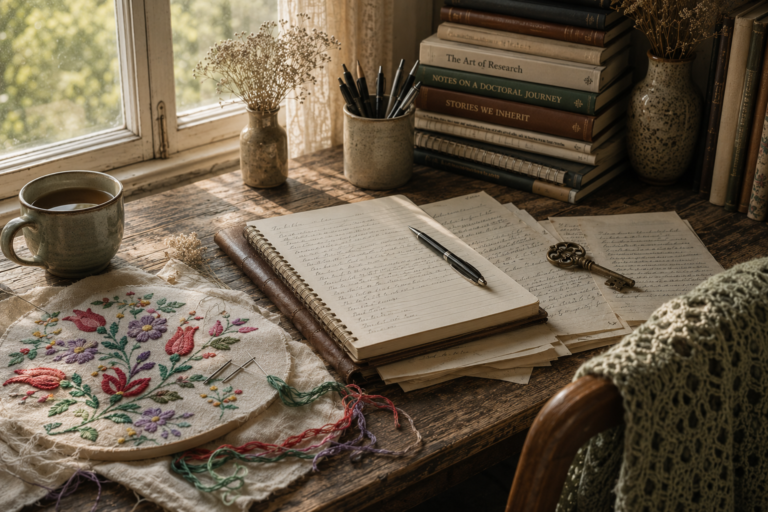
I also told her about the standard thread colours being claret and red, two shades of pink, yellow and orange, dark and light blue, two shades of violet, and two shades of green. So we talked about mounting the embroidery (which is on white linen with white stitching along the border) on red or claret backing board and using a “rustic” moulding (being what laypeople call the “frame”). I told her, “Think village farmhouse.” and she produced the most gorgeous timber – I was in love.
And then something magical happened…
She suggested that I could handwrite a hidden inscription on the inner lip of the spacer that will hold the glass away from the embroidery thread.
My mind immediately became excited – I could take a quote from Ünnepi’s recordings to inscribe alongside one of the pieces. Then a quote from Anyuci to place alongside another. And to complete the triptych, a quote from me.
Of course, the quotes from Ünnepi and Anyuci will be in Hungarian – reflecting their voices. In contrast, mine will be in English – reflecting my voice. Having moved away from, and now reconnecting with, my heritage and culture.