Lost in Translation
Although I am bilingual, for as long as I can remember, I have been far more confident reading and writing in English than in Hungarian. Not because I can’t understand or form sentences—I most certainly can! But when it comes to writing in particular, spelling can be problematic. And, well, finding those special characters on the keyboard really hampers my ability to touch type. But I digress.
In supervision yesterday, I was explaining that I have decided that after transcription, I will only translate the sections of recordings of Ünnepi and Anyuci that I intend to use as part of my “findings” and discussion. Namely, because I feel it is an unnecessary use of time/energy to translate absolutely everything.
Then Kathryn raised an interesting question, “What language do you think in?”
Great question, Kathryn! I think in both!! If I am talking in English, I think in English. When talking in Hungarian, I think in Hungarian.
Then came Kathryn’s follow-up question, “But what about when you’re just thinking—not actually speaking with anyone?”
Another great question! And this one I had to think on for a second (in English, of course). I honestly believe it is contextual—completely dependent upon what the topic is, where I am, and who (if anyone) the subject of consideration is. Of course, currently, my mind is consumed by my doctoral work; and all of the literature that I have engaged with thus far is written in English. But when I was listening to the earlier recordings of Ünnepi, I was absolutely thinking in Hungarian. And it goes without saying that when I’m talking about my work with Anyuci, it is in Hungarian.
Although I have thought about this in the past, it hadn’t occurred to me that I should be documenting this thought process in a research diary. Because ultimately, I need to be able to explain and justify all my research decisions; and deciding on how much of the source material to translate is right up there in importance. (Thanks, Kathryn!)
Which had me circling back to how I might handle the creation of found poetry when it comes to the stories told by Ünnepi and Anyuci. I feel it should be in Hungarian. That is, I would use the same process that I have been using with the found poetry from literature—extracting words and/or phrases that stand out to me, one section at a time. I would then translate the poem into English—not word-for-word, but the essence. Just like we do when we incorporate a karakia to open a meeting; first delivering it in Māori before offering an English translation.
Now that I am reflecting further on this, I think it would be an interesting exercise to take the English translation of the same transcript that I used for the Hungarian found poem to see what emerges as a result; and compare it to the translation of the Hungarian poem. Am I making sense, or have I lost you?
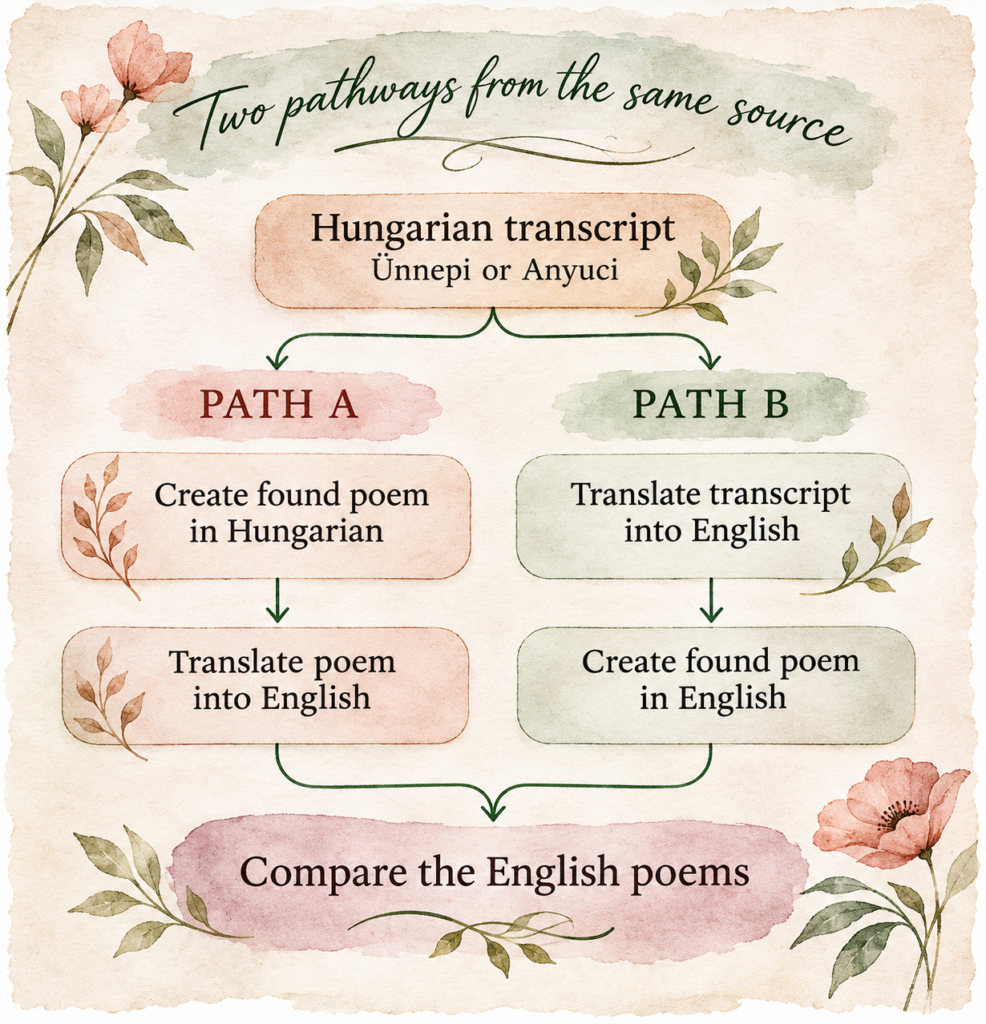
Ultimately, I would hope that the English poem captures the same essence irrespective of at which stage the translation takes place. However, any differences would highlight where things may (quite literally) be lost in translation.